
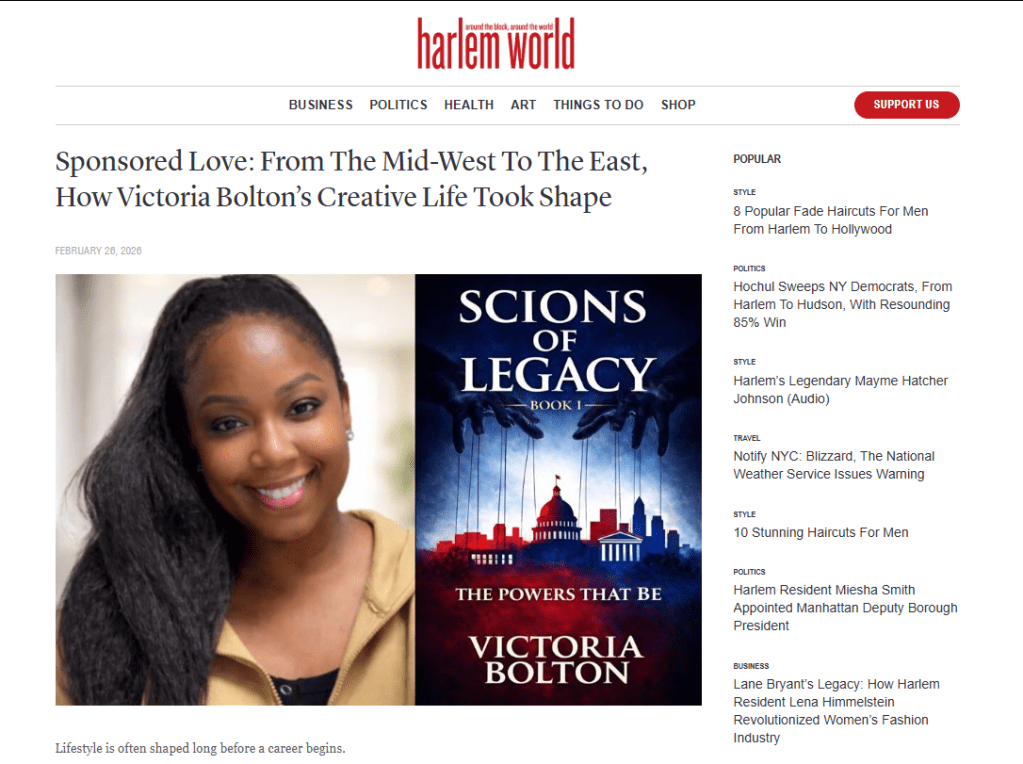
Sponsored Love: From The Mid-West To The East, How Victoria Bolton’s Creative Life Took Shape
Lifestyle is often shaped long before a career begins.
For author Victoria Bolton, the foundation was laid on the South Side of Chicago, where community, reputation, and resilience were not abstract ideas but everyday realities.
Growing up there meant understanding how families carried history and how neighborhoods protected their own. Bolton absorbed those dynamics early, and they later became central themes in her fiction. It was a strong foundation, but she sensed something was missing. She wanted a deeper, more layered history, one that stretched beyond the present moment and carried visible traces of reinvention, conflict, style, and cultural transformation.
Never miss new stories in Harlem
Sign-Up for our free weekly Newsletter *Constant Contact Use. Please leave this field blank.
But even as a young girl in Chicago, her imagination stretched east.
Bolton remembers staying up late and turning to Channel 9 after 9 p.m., back when television stations shifted programming at night. She would watch WWOR-TV, catching New York news broadcasts from hundreds of miles away. Stories about Harlem would appear on the screen. The visuals were distinct. The tone felt different from Chicago. The city looked faster, layered, charged with history.
“I used to sit there thinking, I want to at least visit there,” she says.

Back when she stayed up late watching Channel 9 and catching New York news, there was another quiet detail she rarely admits. While growing up deep in Bulls country, she found herself low-key rooting for the Knicks to beat them. It was not something she could openly express for obvious reasons, but that small, private loyalty said a lot. Even then, part of her was already leaning toward New York.
Those late-night broadcasts created an early fascination. Harlem and the rest of the city were not yet personal, but it was magnetic. The idea of it and the city stayed with her.
Years later, that curiosity became real. After she moved to NY State, Bolton began visiting a relative who lived in Harlem. Those visits moved her from observer to participant. She walked the blocks instead of watching them through a screen. She attended neighborhood festivals filled with music, food vendors, and conversations that felt rooted and unfiltered. She saw neighbors greet each other by name. She noticed the pride residents carried in their buildings and businesses.
“The festivals were vibrant and communal,” she recalls. “It was people living their lives with so much pride and joy. I went past the Apollo and the Cotton Club. It was like I was looking at Black history, the things I used to read about in textbooks.”
RELATED: Help us create the next generation of publishers in Harlem and beyond.
Spending time there allowed her to absorb details that would later anchor her storytelling. The architecture of brownstones. The rhythm of sidewalk conversations. The blend of tradition and evolution. Harlem revealed itself as layered and complex, a place shaped by history yet constantly redefining itself.
That lived familiarity shaped her trilogies, Rude Boy USA and Scions of Legacy. Harlem in her books is not decorative. It influences power dynamics, ambition, loyalty, and consequence. Its proximity to political institutions mirrors the tension her characters face as they navigate influence and reputation.
Bolton says those early news broadcasts sparked curiosity and unknowingly early research, but walking the streets and attending community events gave her depth. The combination allowed her to write with specificity rather than assumption.
Nearly twenty-seven years later, Harlem and New York are no longer chapters in Victoria Bolton’s story. They are home. What began as curiosity and family visits evolved into permanence. She has built her life, career, and creative world here, and she has no plans of leaving. “I feel like this is home to me,” she says. “Being here feels natural.”
Her daily life now reflects balance. By day, she works with children and technology in public schools, guiding young people through structured learning environments. By evening, she transitions into creative mode. Writing becomes a quiet ritual. On some nights, she edits dialogue. On others, she experiments with art, working with different materials to create visual pieces. Creativity is not a hobby for her. It is part of her rhythm.
Her books have drawn criticism for tackling organized crime, political influence, and institutional power, subject matter that some may find negative; however, she does not focus on the negative. The stories are rooted in people, not circumstances. Some readers question why she centers morally complex families. Bolton does not retreat from those questions.
“I write about consequences,” she explains. “People don’t start over without history.
They carry it.” Chicago gave her grounding. Late-night television gave her curiosity. Harlem gave her texture. Together, those influences shaped Victoria Bolton’s creative life, a life built on observation, immersion, and the discipline to turn both into a story.
 Author Victoria Bolton
Leave a comment